
Frequently Asked Questions
-
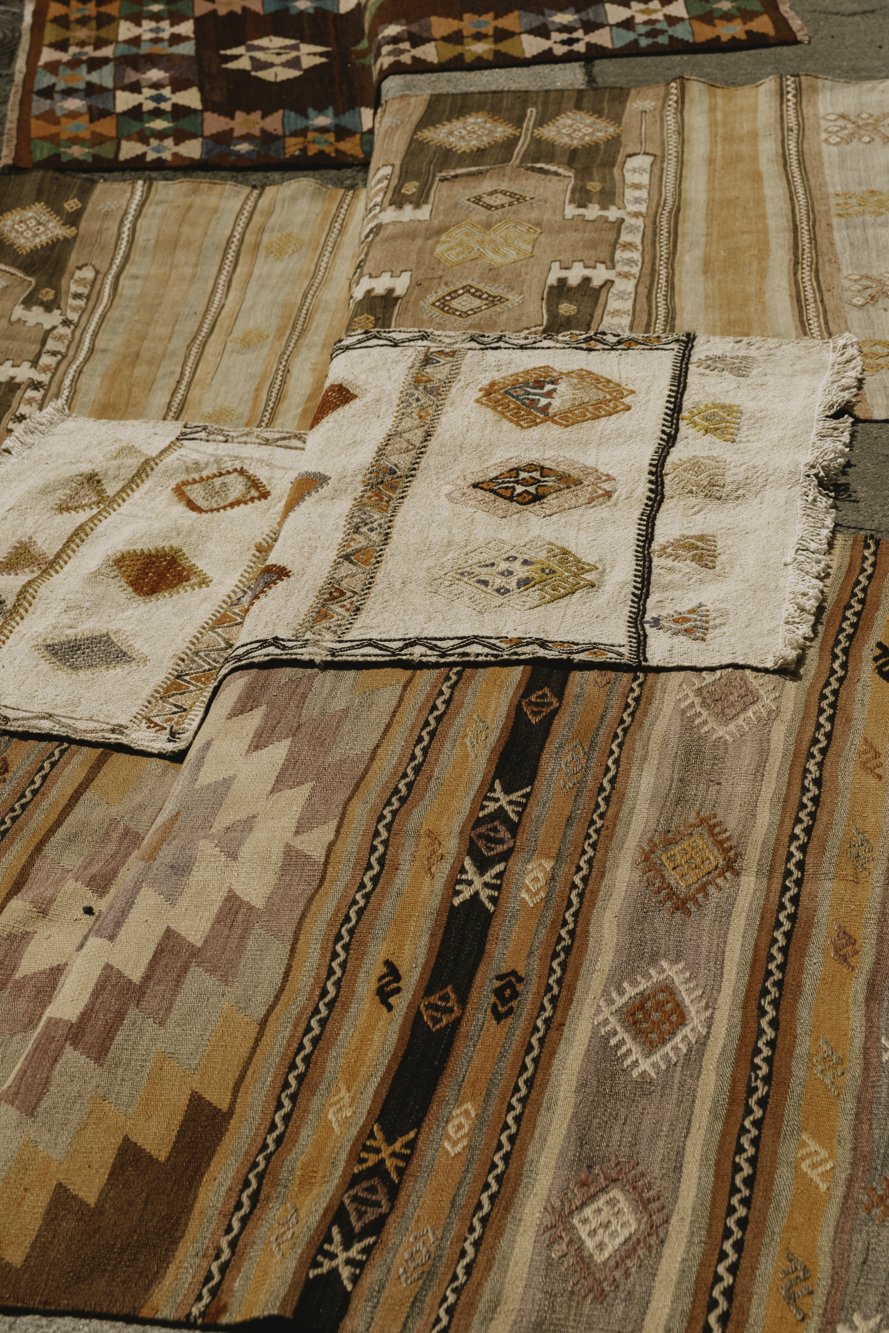
Every kilim in this collection was made by a woman.
Most pieces are vintage or antique, woven across Anatolia and the broader nomadic world over the past century or more. For the women who made them, weaving wasn't just a craft — it was currency. A woman's kilims were her dowry, her proof of skill and worth, and her independence. The more she wove, the more she brought into a marriage. And if she ever needed to leave, her kilims left with her.
That history lives in every knot.
A small number of pieces in the collection are new — Afghan kilims, also handwoven by women, with the same care and tradition, but without that particular personal weight behind them. I always note which is which.
-
Rug is the English umbrella term for all woven, knotted or otherwise produced floor coverings. Beneath it sits a whole family of different weaving techniques — each with a distinct appearance, feel and character. Here are the most important ones from the Anatolian and Caucasian tradition:
FLATWEAVES — NO PILE
Kilim
Warp and weft are densely interlocked, producing a smooth, reversible textile with no pile. Patterns are strictly geometric, colour fields sharply defined. Lightweight, stackable, durable. The purest and most widespread form of Anatolian weaving — what most people picture when they think of a flat rug from the East.Cicim
A kilim at its base, but enriched with supplementary embroidery threads laid over the woven structure. These threads create raised, tactile motifs — often floral or ornamental — giving the surface a subtle three-dimensionality. You see the difference immediately. You feel it when you run your hand across it.Sumak
A wrapping technique: weft threads are wound around the warp rather than simply passed through, creating a dense, durable flatweave with a faintly diagonal herringbone structure. Sumaks are heavier than kilims, with a slightly ridged surface. Originally from the Caucasian-Anatolian border region — named after the city of Shemakha in Azerbaijan.
WITH PILE
Tülü
An Anatolian knotted rug with an exceptionally long, shaggy pile — often made from coarser, undyed wool. Raw, elemental, almost sculptural. Traditionally used as sleeping mats or seat cushions in tents and nomadic homes. Among the oldest rug forms in existence.Knotted rug
The classic oriental carpet. Thousands of knots are tied by hand around the warp threads and then cut, producing a soft, velvety pile surface. The more knots per square decimetre, the finer and more intricate the rug — and the longer it took to make
-
One of the most persistent misconceptions — and worth addressing directly. A piece made from genuine virgin wool is anything but a trap for dirt.
Wool contains lanolin, a natural wax that protects the sheep's fleece — and continues to work within the textile long after it has been woven.
Lanolin makes the fibre resistant to dirt, inhibits the growth of bacteria and mould, and ensures that liquids bead on the surface rather than soaking in immediately.
There is also the structure: kilims and cicims are flatweaves. No deep pile for dust and mites to settle into. Regular shaking out and occasional vacuuming is all that is needed. Anyone with a long, high-pile synthetic rug has the bigger hygiene problem.
LANOLIN
The natural wool wax acts antibacterially and repels dirt — without any chemical additives.
NO DEEP PILE
As flatweaves, kilims and cicims offer dust and mites little refuge — unlike high-pile rugs.
NATURAL FIBRES
Virgin wool regulates moisture and is antistatic — it does not attract dust the way synthetic materials do.
EASY TO MAINTAIN
Shake out, vacuum, blot stains — that is all a piece needs in everyday life.
-
The wool in these pieces is hand-spun virgin wool — shorn from living sheep, spun by the women themselves and dyed with natural colours. Virgin wool is naturally robust, dirt-repellent and long-lasting. It regulates moisture, is antistatic and develops an incomparable patina over the years. A piece made from genuine virgin wool is not a furnishing object — it is a companion.
-
No — and that is their nature. The vintage pieces are handwoven in Anatolia between 1940 and 1960. They were made by women as part of their dowry — with hands, time and a care no machine can replicate. Slight irregularities, minimal wear or colour variation are not flaws. They are signs of authenticity. Every imperfection tells a piece of history.
-
You may notice that some of our kilims carry a number in their product name. This number refers to the region of origin — for example, 40 stands for Kırşehir in Turkey, while 00 indicates a Bulgarian tribal kilim. Afghan kilims carry no number at all. These codes are part of the textile tradition and help us trace each piece back to its roots — they have nothing to do with the order in which a kilim was added to our collection.
-
We currently ship to Austria and all European Union countries — we are working on expanding our destinations in the future, so stay tuned.
All orders are delivered free of charge, no matter where you are in the EU.
Delivery within Austria usually takes 3–4 business days; for other EU countries, please allow 4–7 business days depending on your location.
Once your order has been shipped, you will receive an automatic tracking email so you can follow your kilim on its journey to you.
If you have any questions about your order, we are always happy to help — just reach out to us at hello@rugsofnumi.com.
-
I am robust — but I appreciate a little care.
Shake me out regularly and vacuum me gently in the direction of the pile. Blot fresh stains with a slightly damp cloth — never rub.Keep me out of direct sunlight and rotate me occasionally so I wear evenly.
A professional clean every few years is ideal — no washing machine, please. I am handmade and I deserve handwork.
-
We want you to love your kilim. If for any reason you are not completely satisfied, you can return your order within 14 calendar days of receiving it.
To start a return, simply send us an email at hello@rugsofnumi.com with your order number and we will guide you through the process.
Please ensure the kilim is returned in its original, unused condition.
Kilims must be rolled and returned in the original shipping tube they arrived in — this is the only packaging that provides adequate protection during transit. We are not liable for damage caused by inadequate packaging, and returns that arrive damaged due to improper packaging may not be eligible for a full refund.Return shipping costs are the responsibility of the buyer.
Once we have received and inspected the returned kilim, we will process your refund within 14 calendar days — using the same payment method you used for your order.
Please note: Vintage and antique kilims cannot be returned solely on the basis of typical signs of age and wear — including abrash, patina, small holes, thinning areas or wear to edges and fringes. These are inherent characteristics of historical hand-woven textiles, not defects, and are communicated in our product descriptions prior to purchase.
Once we have received and inspected the returned kilim, we will process your refund within 7 business days.